
You Don’t Need a Gym to Build Real Muscle
The best home workout to gain muscle uses compound bodyweight movements and progressive overload to drive real hypertrophy — no gym membership required. Here’s a quick look at what works:
Top muscle-building exercises you can do at home:
- Push-ups (and variations: diamond, decline, archer)
- Squats (bodyweight, jump squats, pistol squats)
- Lunges (walking, reverse, Bulgarian split squat)
- Inverted rows (using a table or resistance bands)
- Pike push-ups (for shoulders)
- Glute bridges and hip thrusts
- Dips (using a chair or low surface)
- Planks and core work
Key principles that make it work:
- Train to near failure on every set
- Apply progressive overload week by week
- Hit each muscle group at least twice per week
- Fuel with enough protein (roughly 0.8–1g per pound of bodyweight)
- Prioritize sleep and recovery
The idea that you need heavy barbells and a full gym to build muscle is one of the most persistent myths in fitness. Research tells a different story. A study comparing press-up training to bench press found that after eight weeks, both groups made comparable gains in muscle and strength. Another widely cited review found that training at least two days a week is enough to stimulate muscle growth — and even a single set per exercise, once a week, can be effective in the first three months.
The living room, the backyard, a small spare room — these are all valid weight rooms. What matters is how you train, not where.
This guide breaks down exactly how to turn your home into a muscle-building environment, whether you’re starting from scratch or ready to push past a plateau.

The Science of Hypertrophy: Building Muscle Without the Gym
To understand the best home workout to gain muscle, we first need to understand how muscles actually grow. This process is called hypertrophy. Your body doesn’t know if you are lifting a $500 chrome dumbbell or a heavy jug of laundry detergent; it only knows tension and stress.
There are three primary drivers of muscle growth that we can trigger right in our living rooms:
- Mechanical Tension: This is the “heavy” feeling. It occurs when you move through a full range of motion under load. At home, we create this by using our body weight or household items.
- Metabolic Stress: Have you ever felt that “burn” in your muscles during a high-rep set? That’s metabolic stress. It’s the buildup of metabolites like lactate, which signals the body to release growth-promoting hormones.
- Muscle Failure (or Near Failure): Science shows that as long as you push yourself close to the point where you can’t do another rep with good form, you can grow muscle. Whether you do 5 reps with a heavy weight or 30 reps with your body weight, the growth stimulus is remarkably similar if the effort is high.
We’ve found that many people overcomplicate this. You don’t need a PhD in kinesiology to get results. By focusing on building muscle with home exercises, you can simplify your routine and focus on what matters: high-intensity effort.
The Best Home Workout to Gain Muscle: Essential Exercises and Equipment
When we talk about the best home workout to gain muscle, we focus on compound movements. These are exercises that use multiple joints and muscle groups at once. Think of them as the “biggest bang for your buck” movements.
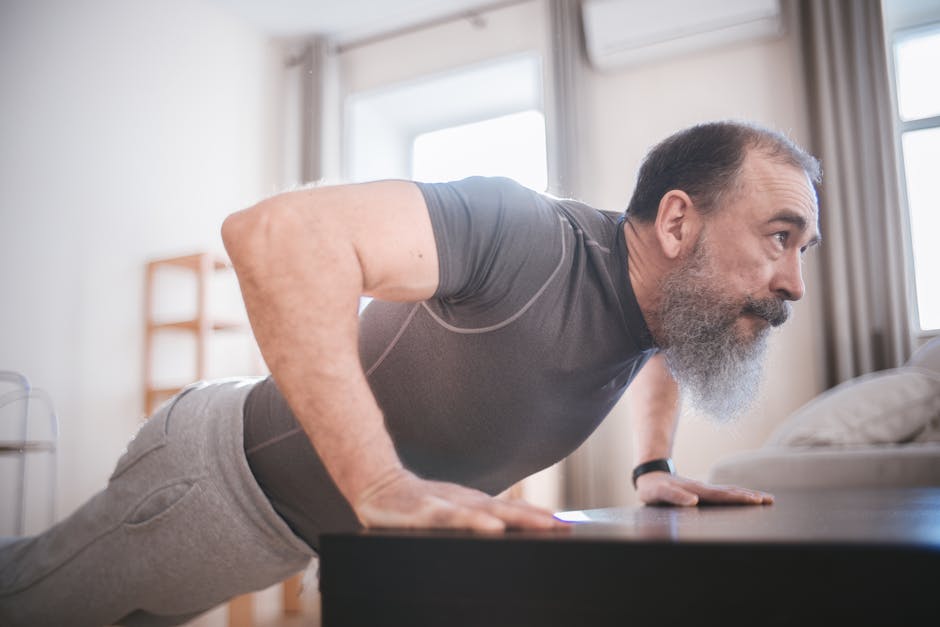
The Core Movements
To build a balanced physique, our home routine should include variations of these four patterns:
- Push: Targets chest, shoulders, and triceps (e.g., Push-ups, Dips).
- Pull: Targets back and biceps (e.g., Inverted rows, Pull-ups).
- Squat: Targets quads and glutes (e.g., Air squats, Bulgarian split squats).
- Hinge: Targets hamstrings and lower back (e.g., Glute bridges, Romanian deadlifts with a backpack).
For more detailed breakdowns, check out our guide on full body strength exercises for home workouts.
Bodyweight vs. Minimal Equipment
You can absolutely build muscle with zero equipment, but adding a few items can speed up the process.
| Feature | Bodyweight Only | Minimal Equipment (Dumbbells/Bands) |
|---|---|---|
| Difficulty | Easier to start, harder to progress later | Easier to adjust resistance precisely |
| Space | Zero footprint | Requires a small corner or closet |
| Cost | Free | Small initial investment |
| Targeting | Harder to hit the “pull” muscles (back) | Very easy to target every muscle group |
Structuring the Best Home Workout to Gain Muscle for Beginners
If you are just starting, your goal isn’t to do 100 push-ups on day one. It’s to learn the movement patterns. We recommend bodyweight strength training for beginners because it builds a foundation of joint stability before you add extra weight.
A Sample Beginner Routine (Perform 2-3 times per week):
- Wall Push-ups: 3 sets of 10-15 reps. Great if standard push-ups feel too heavy.
- Air Squats: 3 sets of 12-15 reps. Focus on sitting back into your heels.
- Inverted Rows: 3 sets of 8-10 reps (using a sturdy table or low bar).
- Glute Bridges: 3 sets of 15 reps. Squeeze your glutes at the top.
- Plank: 3 sets, holding for 20-30 seconds.
Always prioritize form over reps. If your back starts to arch or your knees cave in, stop the set. We want muscle gains, not joint pains!
Advanced Variations for the Best Home Workout to Gain Muscle
Once you can easily smash through 20+ reps of basic exercises, it’s time to level up. To keep growing, you need to make the movements harder. This is where equipment-free strength training routines get creative.
- Pistol Squats: A one-legged squat that requires incredible balance and leg strength.
- Archer Push-ups: Shifting your weight to one arm at a time to increase the load on the chest.
- Decline Push-ups: Putting your feet on a chair to target the upper chest and shoulders.
- Bulgarian Split Squats: Elevating your back foot on a sofa to torch your quads.
The “Muscle-Mind Connection” is also vital here. Instead of just “moving” through the rep, focus on squeezing the target muscle as hard as possible at the top of the movement.
Mastering Progressive Overload and Proper Form
The biggest mistake people make with the best home workout to gain muscle is doing the exact same thing every week. If you did 10 push-ups last Monday and you do 10 push-ups this Monday, your body has no reason to grow. You must apply Progressive Overload.
Ways to Progress at Home:
- Increase Reps: If you did 10 last week, aim for 11 or 12 this week.
- Shorten Rest Intervals: Instead of resting for 90 seconds, rest for 60. This increases metabolic stress.
- Improve Tempo (Time Under Tension): This is a secret weapon for home trainers. Instead of dropping down in a squat, take 3 full seconds to lower yourself (the eccentric phase). This creates more micro-tears in the muscle, which leads to growth.
- Increase Range of Motion: Deepen your lunges or use “deficit” push-ups (hands on books) to stretch the muscle further.
For those looking for a structured approach, we offer deeper insights into strength training at home that covers these variables in detail.
Nutrition and Recovery: The Foundation of Home Gains
You don’t grow muscle during your workout; you grow while you sleep and eat. Think of your workout as the “order” and your nutrition as the “delivery.” If you don’t provide the materials, the building doesn’t happen.
The Protein Powerhouse
Protein is the building block of muscle. For home training to be effective, aim for roughly 1.6g to 2.2g of protein per kilogram of body weight. This ensures your body has enough amino acids for protein synthesis.
- Check out our list of protein-rich foods for home training to help hit your goals.
The Caloric Surplus
While beginners can sometimes build muscle while losing fat, most people will see the best home workout to gain muscle results by eating in a slight caloric surplus (250–500 calories above maintenance). This provides the energy needed for intense training and tissue repair. You can find more specific nutrition advice for building strength on our blog.
Recovery and Sleep
Muscles need time to recover. Training the same muscle group every single day is actually counterproductive. Aim to hit each muscle group 2–3 times a week, with at least 48 hours of rest in between.
- Sleep: Aim for 7–9 hours. This is when growth hormone is at its peak.
- Recovery Foods: Don’t forget muscle recovery foods like tart cherries, fatty fish, and complex carbs to replenish glycogen.
Conclusion
Building an impressive physique doesn’t require a monthly gym bill or a commute. The best home workout to gain muscle is the one you actually stick to. By mastering compound movements, pushing yourself to near failure, and fueling your body correctly, you can achieve professional-level results from the comfort of your living room.
At Lar Confortavel, we believe that fitness should be accessible to everyone, regardless of their equipment or location. Consistency is your greatest ally. Start small, stay dedicated, and watch your body transform.
Ready to take the next step? Explore our full library of workout routines to find the perfect plan for your goals.
Can you really gain muscle at home without gym equipment?
Yes, absolutely. Hypertrophy (muscle growth) is a biological response to resistance, not a specific location. By using your body weight and manipulating variables like tempo, reps, and mechanical advantage (e.g., moving from regular push-ups to one-arm variations), you can provide enough resistance to stimulate significant muscle growth. The key is consistency and ensuring the exercises remain challenging as you get stronger.
How often should I train to see results?
For most people, training 3 to 5 times per week is the “sweet spot.” This allows you to hit each major muscle group at least twice a week while still providing enough time for recovery. If you are a beginner, you might want to start with full body workouts for beginners at home three times a week (e.g., Monday, Wednesday, Friday) to allow your joints and nervous system to adapt.
What is the most important factor for home muscle growth?
The most important factor is Progressive Overload. Without a gym, it is easy to fall into a “maintenance” trap where you do the same comfortable routine every day. To grow, you must constantly increase the demand on your muscles by adding reps, improving your form, slowing down your movements, or trying harder exercise variations. Combined with high effort intensity and proper nutrition, progressive overload is the engine that drives muscle gain.
