
The Truth About 1200 Calories Per Day Weight Loss (And Whether It Will Work for You)
1200 calories per day weight loss is one of the most searched diet topics online — and for good reason. It promises a simple, clear target. But does it actually work, and is it safe?
Here’s the quick answer:
| Question | Quick Answer |
|---|---|
| Will you lose weight? | Yes, for most people it creates a calorie deficit |
| How fast? | 1-2 lbs per week (after initial 3-5 lb water weight drop) |
| Is it safe for everyone? | No — especially not for active people, men, or athletes |
| Minimum for most women | 1,200 cal/day (per Dietary Guidelines for Americans) |
| Minimum for most men | 1,500-1,600 cal/day |
| Key to success | Nutrient-dense foods, adequate protein, and consistency |
The idea of eating exactly 1,200 calories a day has been around since 1918, when author Lulu Hunt Peters published one of the first diet books recommending that number for women. Over a century later, it still shows up as the default in apps, doctor handouts, and nearly every weight loss article online.
But here’s the problem: most adults burn more than 1,200 calories just by existing. For most women, the resting metabolic rate (the calories your body burns doing nothing) falls between 1,300 and 1,600 calories per day. For active individuals, the gap is even larger.
That doesn’t mean 1,200 calories is useless. It means context matters. A shorter, sedentary older woman and a younger woman who runs three times a week have completely different needs — and the same number won’t serve both of them equally.
This guide breaks down exactly how to approach 1200 calories per day weight loss in a way that’s practical, sustainable, and won’t leave you exhausted or ravenous.
Is a 1200 Calories Per Day Weight Loss Plan Right for You?
Before we dive into what to eat, we need to talk about whether you should be eating this little at all. We often think of 1,200 as a “magic number,” but in reality, it is the absolute floor for nutritional safety for most women.
Your body is like a high-end car. Even when it’s parked (that’s your Resting Metabolic Rate or RMR), the engine is still humming. It’s pumping blood, breathing, and regenerating cells. For most of us, that “idling” cost is actually higher than 1,200 calories. When we drop below that baseline, our bodies can start to get a little cranky.
A 1200 calories per day weight loss plan is typically most appropriate for:
- Shorter women with smaller frames.
- Sedentary individuals (those who don’t move much during the day).
- Older adults whose metabolism has naturally slowed down.
If you are a 6-foot-tall man who hits the gym five times a week, 1,200 calories isn’t a diet; it’s a recipe for a “hangry” disaster. According to experts at the Cleveland Clinic, while some can safely lose weight at this level, it is highly individualized. We always recommend checking out our Balanced Diet Tips for Active Lifestyles to see how activity levels change your “fuel” requirements.
Calculating Your Personal Calorie Needs
So, how do we know if 1,200 is your number or if you’d fare better at 1,500? We can use a simple formula to find your starting point.
To estimate your maintenance calories (the amount you need to stay at your current weight), multiply your current weight by 12 if you are sedentary, or by 15 if you are moderately active.
Example: If you weigh 160 lbs and don’t exercise much: 160 x 12 = 1,920 calories for maintenance.
To lose about one pound of fat per week, you need to create a 500-calorie daily deficit. 1,920 – 500 = 1,420 calories.
In this case, a 1,420-calorie plan is actually a better starting point than jumping straight to 1,200. If your calculation results in a number lower than 1,200, experts suggest setting your goal at 1,200 anyway to ensure you get enough vitamins and minerals. For more help on these calculations, read our Nutrition Tips for Weight Loss.
Who Should Avoid 1200 Calories Per Day Weight Loss?
We want you to reach your goals, but we also want you to be healthy enough to enjoy them! Certain groups should steer clear of such a restrictive limit:
- Active Men: Men generally have more muscle mass and larger frames. Dropping below 1,500-1,600 calories can lead to muscle wasting and extreme fatigue.
- Athletes: If you’re training for a 5K or lifting heavy weights, your body needs more glycogen (energy) to recover.
- Pregnant or Nursing Women: Your body is literally building another human; now is not the time for a steep deficit.
- Teenagers: Growth requires a massive amount of energy.
One major risk of going too low is “metabolic adaptation.” This is when your body thinks it’s in a famine and starts burning fewer calories to “save” you. This can actually stall your progress. As noted in this WebMD guide, very low-calorie diets can sometimes reduce your resting metabolic rate by 20-25%.
The Science of Success: Timeline and Metabolic Reality
Let’s talk about the big question: “How long will it take?”
If you have a goal to lose 30 pounds, you might be tempted to slash calories to the bone to get there by next Tuesday. But the math of 1200 calories per day weight loss tells a different story.
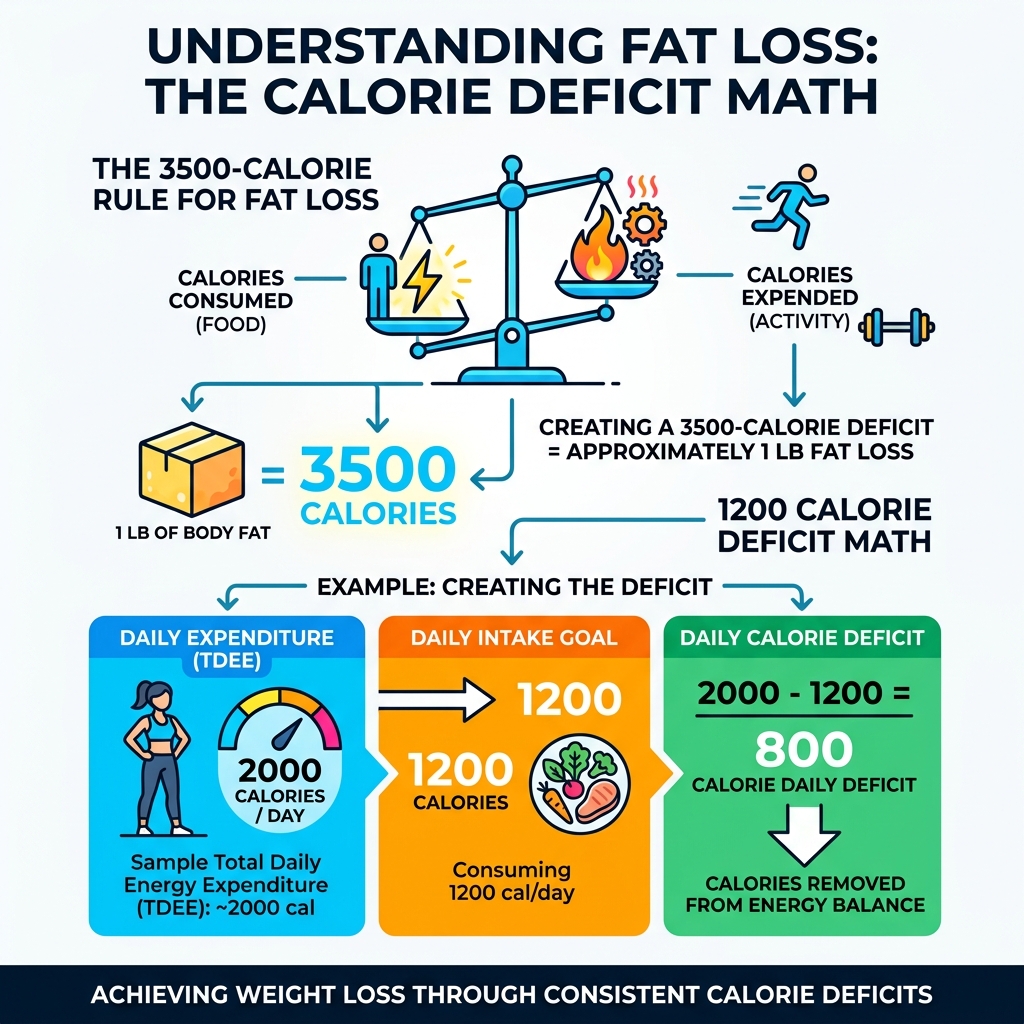
To lose one pound of fat, you need a deficit of roughly 3,500 calories. If your maintenance is 1,800 and you eat 1,200, you have a 600-calorie daily deficit.
- 30 lbs x 3,500 calories = 105,000 total calories to burn.
- 105,000 / 600 = 175 days.
That’s about 5.8 months. While that might feel like a long time, it’s a timeline that actually allows your skin to adjust and your habits to stick.
In the first week, you might see the scale drop by 3 to 5 pounds. Don’t get too excited—this is usually water weight and glycogen depletion. Real fat loss is a steady 1 to 2 pounds per week. To help speed things along safely, consider adding some Fat Loss Best Cardio Exercises at Home to your routine.
A Sample 1200 Calories Per Day Weight Loss Meal Plan
When you only have 1,200 calories to work with, every bite has to “earn its keep.” You can’t spend 400 calories on a sugary latte and expect to feel full for the rest of the day. We need to focus on volume eating—filling your plate with foods that take up a lot of space but don’t have many calories.
| High-Volume Foods (Eat More!) | Low-Volume Foods (Eat Mindfully) |
|---|---|
| Spinach, Broccoli, Peppers | Butter, Oil, Salad Dressing |
| Egg Whites, Greek Yogurt | Full-fat Cheese, Bacon |
| Berries, Watermelon | Dried Fruit, Fruit Juice |
| Beans, Lentils, Broth-based Soups | White Bread, Pastries |
To keep your muscles intact while losing fat, aim for a high protein intake (about 60-80g per day) and plenty of fiber (25-35g). This is much easier if you follow a solid Meal Prep for Home Workouts strategy.
Breakfast and Lunch Ideas (300-350 Calories)
We like to keep breakfast simple. You don’t need a five-course meal to start the day.
- Option 1: 3/4 cup bran flakes with a banana and a cup of non-fat milk.
- Option 2: Greek yogurt parfait with berries and a sprinkle of granola.
- Option 3: Oatmeal with cinnamon and half an apple.
For lunch, think “Protein + Fiber.” A tuna salad (made with Greek yogurt or light mayo) in a whole-wheat pita with plenty of cucumber and sprouts is a winner. Or, try a black bean salad with lime and cilantro. For more inspiration, we have a list of Simple Meal Plans for Fitness Beginners that fit perfectly into a busy schedule.
Dinner and Snacks on 1200 Calories
Dinner is usually when we’re the hungriest, so we recommend saving about 400-500 calories for this meal.
- The Classic: 4 oz of grilled salmon, a small baked potato (with salsa instead of butter!), and two cups of steamed broccoli or green beans.
- The Stir-Fry: Shrimp or tofu sautéed with a mountain of bell peppers, snap peas, and bok choy over a small serving of quinoa.
Don’t forget the snacks! A snack can be the difference between staying on track and raiding the pantry at 9 PM. We suggest keeping snacks between 50 and 100 calories. Think 10 baby carrots with 2 tablespoons of hummus or a small apple. Check out our Healthy Snack Ideas for Fitness for more “sanity-saving” options.
Strategies to Stay Full and Avoid the Binge-Restrict Cycle
The biggest enemy of 1200 calories per day weight loss is the “Monday-Friday trap.” This is where you are incredibly strict for five days, but because you feel so deprived, you eat 3,000 calories a day on Saturday and Sunday. This averages out your calories to a level where you might not lose any weight at all!
To avoid this, we focus on satiety. Fiber and protein are your best friends here. They slow down digestion and tell your brain, “Hey, we’re full!” If you find yourself constantly hungry, it’s a sign you might need to swap some processed carbs for more Healthy Meals for Fitness Enthusiasts that prioritize whole foods.
Managing Side Effects and Metabolic Slowdown
Let’s be real: eating 1,200 calories can sometimes make you feel a bit tired or “foggy” at first. This is often because your body is adjusting to using its own fat stores for energy. However, if you feel dizzy or weak, that is a sign your deficit is too steep.
To protect your health:
- Take a Multivitamin: When you eat less food, it’s harder to get all your micronutrients (like Vitamin D, Iron, and Calcium). Check out our guide on Vitamins and Supplements for Beginners to fill the gaps.
- Prioritize Sleep: Lack of sleep spikes cortisol and ghrelin (the hunger hormone), making it almost impossible to stick to a diet.
- Hydrate: Sometimes your brain confuses thirst for hunger. Drink a glass of water before you reach for a snack.
How to Integrate Exercise Safely
You might think that if 1,200 calories is good, 1,200 calories plus two hours of cardio is better. Stop right there!
Doing intense HIIT or heavy lifting on a very low-calorie diet can actually cause your body to burn muscle instead of fat. Muscle is metabolically active—it burns calories even while you sleep. We want to keep it!
We recommend:
- Focus on NEAT: Non-Exercise Activity Thermogenesis. This just means moving more in your daily life—taking the stairs, walking the dog, or gardening.
- Strength Training: Lifting weights 2-3 times a week helps preserve muscle mass.
- Training Day Adjustments: If you have a particularly active day, don’t be afraid to add 200 calories of protein to your plan to help your body recover. Our Diet Plan for Home Workout Beginners covers exactly how to balance food and movement.
Frequently Asked Questions about 1200-Calorie Diets
We hear a lot of the same concerns from our community, so let’s clear up some common mysteries.
How much weight can I lose in a month?
Most people can realistically lose 4 to 8 pounds of fat in a month on a 1200 calories per day weight loss plan. You might see a bigger drop in the first month due to water weight, but don’t expect that “lightning speed” to continue forever. Slow and steady is what keeps the weight off long-term.
Can I drink coffee or alcohol on this plan?
Black coffee and tea are virtually calorie-free and can actually help suppress appetite. However, be careful with the “fancy” lattes—one medium latte can be 200 calories, which is nearly 20% of your daily allowance! As for alcohol, it provides “empty calories” and often leads to poor food choices (looking at you, late-night pizza). If you do indulge, stick to a single glass of wine or a light spirit with soda water.
What if I hit a weight loss plateau?
Plateaus are a normal part of the journey. Often, it’s your body’s way of “resetting.” If you haven’t lost weight in three weeks, try a “maintenance week” where you eat 1,600-1,800 calories to give your metabolism a break, then return to your 1,200-calorie plan. Also, make sure you are staying hydrated! Proper Hydration Tips for Home Workouts can actually help flush out excess water retention that might be masking fat loss on the scale.
Conclusion
At the end of the day, 1200 calories per day weight loss is a tool, not a life sentence. It can be a fantastic way to jumpstart your health journey or help those with lower caloric needs reach their goals. However, the most successful “dieters” are the ones who eventually stop dieting and start living a balanced lifestyle.
Remember to listen to your body. If you’re feeling exhausted or miserable, it’s okay to bump your calories up to 1,400 or 1,500. Sustainability is the secret sauce to long-term health. We are here to support you every step of the way—from your first meal prep to your hundredth workout.
Ready to take the next step? Start your fitness journey today with our custom workout routines designed to work in harmony with your new healthy eating habits!
