
You Don’t Need a Gym to Build Serious Muscle
The best at home workouts to gain muscle combine compound bodyweight movements, smart progression, and consistent effort — no membership required.
Top at-home exercises for muscle gain:
- Push-up variations (chest, shoulders, triceps)
- Pull-ups or inverted rows (back, biceps)
- Squats and lunges (quads, hamstrings, glutes)
- Glute bridges (glutes, hamstrings)
- Dips (triceps, chest)
- Planks and core work (abs, obliques, lower back)
Quick-start rules that actually work:
- Train at least 2 days per week (research supports this as the minimum for muscle growth)
- Aim for 8-15 reps per set, pushing close to failure
- Rest 30 seconds to 2 minutes between sets
- Add difficulty over time — more reps, slower tempo, harder variations
Here’s the thing most people get wrong: they assume building muscle requires heavy barbells and expensive machines. It doesn’t.
Research published in Physiology & Behaviour found that muscle growth can happen independently of external load, as long as exercises are performed through a full range of motion. A separate study in the Journal of Exercise Science & Fitness found that push-up training was comparably effective to bench press for muscle and strength gains over 8 weeks.
The real requirement isn’t a gym. It’s enough challenge on the muscle, applied consistently over time.
Whether you’re working with just your bodyweight, a pair of dumbbells, or a resistance band, this guide breaks down exactly what to buy, what to do, and how to structure it all for real results at home.
The Science and Benefits of Home Hypertrophy
When we talk about “hypertrophy,” we’re just using a fancy word for muscle growth. To trigger this at home, we need to understand the three main drivers of growth: mechanical tension, metabolic stress, and muscle damage.
Mechanical tension is the “heavy” feeling of a muscle working against resistance. Metabolic stress is that famous “burn” you feel during high-repetition sets. By building muscle with home exercises, we can manipulate these factors without needing a 500-pound barbell.
One of the most powerful tools in our arsenal is progressive overload. This is the gradual increase of stress placed upon the body during exercise. At the gym, you just add another plate to the bar. At home, we get creative. We might increase the number of repetitions, slow down the tempo (taking 5 seconds to lower yourself in a push-up), or decrease rest periods to keep the heart rate up and the muscles under tension.
The benefits of staying home go beyond just avoiding that one person who grunts too loudly at the gym. Training at home offers:
- Unmatched Convenience: No commute means you can squeeze in a session while the laundry is drying.
- Cost Savings: No monthly membership fees or expensive “fitness-inspired” smoothies at the juice bar.
- Mental Wellbeing: Studies show that strength training can significantly improve symptoms of anxiety and depression.
- Greater Training Stimulus: Interestingly, a CrossFit study found that a 20-minute bodyweight AMRAP (As Many Rounds As Possible) of pull-ups, push-ups, and squats provided a “greater training stimulus” than running on a treadmill at 85% of maximal heart rate for the same duration.
Science proves that as long as you push your muscles close to failure—meaning you couldn’t do another rep with good form if someone offered you a million dollars—your body will adapt by getting stronger and larger.
Essential Equipment for the Best At Home Workouts to Gain Muscle
While you can absolutely start with nothing but the floor and your own determination, a few strategic “purchases” (or household scavenges) can accelerate your progress.
| Feature | Bodyweight Only | Minimal Equipment |
|---|---|---|
| Cost | $0 | $20 – $100 |
| Ease of Progression | Moderate (requires variation) | High (add weight/resistance) |
| Space Required | Very Low | Low |
| Muscle Targeting | Excellent for Core/Chest/Legs | Better for Back/Biceps |
If you are looking to optimize your strength training at home, consider these essentials:
- Resistance Bands: These are the ultimate space-savers. They provide “accommodating resistance,” meaning the exercise gets harder as the band stretches.
- Doorway Pull-up Bar: Pulling movements are the hardest to replicate with just bodyweight. A pull-up bar is a game-changer for your back and biceps.
- Exercise Mat: Your joints will thank us. It provides grip and cushioning for planks, push-ups, and floor work.
- Weighted Backpack: Fill an old backpack with books or water bottles. Suddenly, your standard lunges become a high-intensity muscle builder.
- Household Substitutes: Use a sturdy chair for dips, gallon water jugs for bicep curls, or a heavy laundry detergent bottle for goblet squats.
The goal is to create resistance. Your muscles don’t know the difference between a high-end dumbbell and a backpack full of encyclopedias—they only know that things are getting heavy.
The Exercise Catalog: Building Muscle Without a Gym
To see real gains, we need to focus on compound movements. These are exercises that use multiple joints and muscle groups at once.
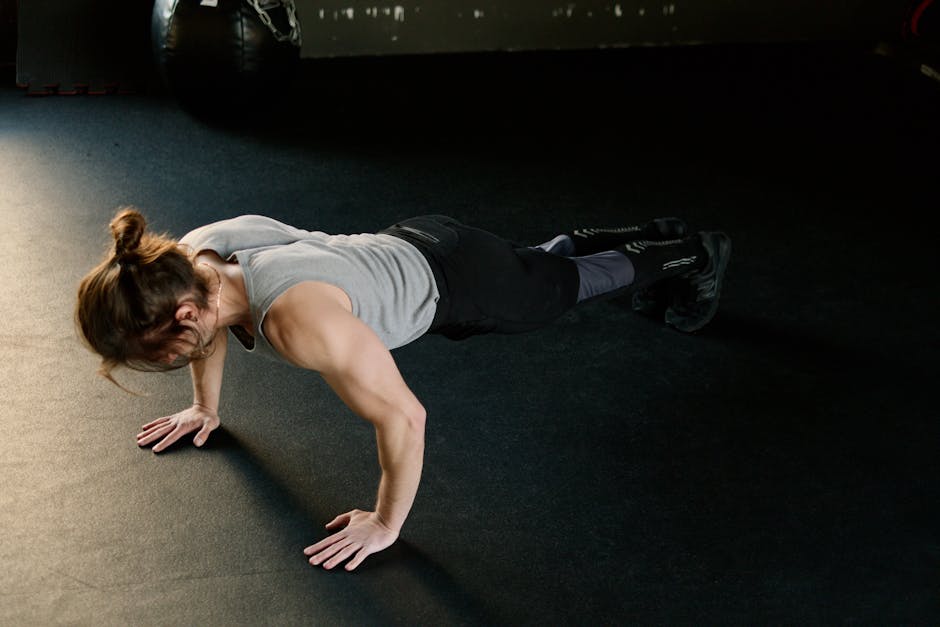
Upper Body: Pushing and Pulling
For the chest, shoulders, and triceps, the Push-up is king. But don’t just stick to the standard version. Diamond push-ups (hands close together) shift the focus to your triceps and inner chest. If those are too easy, elevate your feet on a chair to perform Incline Push-ups, which target the upper chest and shoulders.
For the back and biceps, bodyweight strength training for beginners often starts with the Inverted Row. You can do this by lying under a sturdy table, grabbing the edge, and pulling your chest toward the underside. If you have a doorway bar, Pull-ups and Chin-ups are the gold standard for building a wide, powerful back.
Lower Body: The Foundation
Squats are non-negotiable. To make them harder, try Goblet Squats (holding a heavy object at your chest) or Bulgarian Split Squats (one foot elevated on a chair behind you). The latter is particularly effective because it forces each leg to work independently, correcting muscle imbalances.
Don’t forget the posterior chain (glutes and hamstrings). Glute Bridges and Single-leg Romanian Deadlifts (using a water jug for weight) will ensure your legs look as strong as they feel.
Core: The Anchor
A strong core isn’t just about six-pack abs; it’s about stability. In-home core strengthening exercises like Planks, Dead Bugs, and Mountain Climbers should be staples in your routine. For a more advanced challenge, try the RKC Plank, where you actively squeeze your glutes and pull your elbows toward your toes while holding the position—it makes a 30-second plank feel like an hour.
Programming and Structuring Your Home Routine
Having a list of exercises is great, but a plan is what gets results. We recommend a structured approach to ensure you aren’t just “exercising,” but actually “training.”
A solid total body strength workout at home should be performed 3 to 4 times a week. This allows for adequate recovery, which is when the actual muscle growth happens.
One highly effective method is Daily Undulating Periodization (DUP). This sounds complicated, but it just means varying your rep ranges. For example:
- Monday: 8–12 reps (Hypertrophy focus)
- Wednesday: 15–20 reps (Endurance/Metabolic stress focus)
- Friday: 5–8 reps (Strength focus—use your heaviest variations or weighted backpack here)
Research suggests DUP can produce roughly twice the strength gains compared to static programming where you do the same thing every day.
Beginner Strategies for the Best At Home Workouts to Gain Muscle
If you’re just starting, focus on form over intensity. We recommend a full-body split 2 or 3 times a week.
- Frequency: At least 2 days a week (as per NHS and research guidelines).
- Focus: Master the basic full-body strength exercises for home workouts.
- Progression: Once you can do 15 clean reps of a bodyweight exercise, it’s time to move to a harder variation (e.g., from knee push-ups to full push-ups).
Advanced Progressions for the Best At Home Workouts to Gain Muscle
For those who have been training for a while, an equipment-free strength training routine needs more “bite.”
- Tempo Manipulation: Spend 3-5 seconds on the eccentric (lowering) phase of every lift.
- Shortened Rest: Cut rest periods down to 30-45 seconds to increase metabolic stress.
- Training to Failure: Ensure your final set of each exercise is taken to the point where your form begins to break down.
- Unilateral Work: Shift to single-arm or single-leg versions of every exercise to increase the relative load on the muscle.
Nutrition, Recovery, and Avoiding Common Mistakes
You can do the best at home workouts to gain muscle every single day, but if you aren’t eating and sleeping right, your muscles won’t grow. It’s like trying to build a house without any bricks.
Fueling the Gains
To build muscle, you generally need to be in a caloric surplus (eating more than you burn). A modest surplus of 250–500 calories above maintenance is usually enough to fuel growth without excessive fat gain.
Protein is the most important macronutrient here. Aim for roughly 0.8 to 1 gram of protein per pound of body weight. Check out our nutrition advice for building strength for a deeper dive.
Good sources of protein-rich foods for home training include:
- Chicken breast, lean beef, and fish.
- Eggs and Greek yogurt.
- Lentils, chickpeas, and tofu for plant-based gains.
The Power of Recovery
Muscle growth happens while you sleep, not while you’re sweating. Aim for 7-9 hours of quality shut-eye. Additionally, incorporating the best foods for muscle recovery—like tart cherry juice, blueberries, and omega-3 rich salmon—can help reduce soreness and get you back to your next session faster.
Common Mistakes to Avoid
- Neglecting Progressive Overload: If you do 10 push-ups every day for a year, you’ll get good at doing 10 push-ups, but you won’t keep growing. You must make it harder over time.
- Inconsistency: Skipping weeks at a time is the fastest way to stall.
- Poor Form (Ego Lifting): Even at home, trying to do a “one-arm push-up” with terrible form won’t help. It just leads to injury.
- Ignoring the Back: Many home trainees focus only on what they see in the mirror (chest and abs). Don’t forget your “pull” exercises!
Frequently Asked Questions about Home Muscle Building
Can you effectively build muscle at home without a gym membership?
Absolutely. As mentioned earlier, research shows that bodyweight exercises like push-ups can be just as effective as bench pressing for muscle hypertrophy, provided the effort is high and the range of motion is full. The “greater training stimulus” found in bodyweight AMRAPs compared to steady-state cardio further supports this.
How do I apply progressive overload with just my bodyweight?
You have several levers to pull:
- Increase Reps: Go from 10 to 12 to 15 reps.
- Change the Angle: Elevate your feet for push-ups or your hands for rows.
- Adjust Tempo: Slow down the movement to increase “time under tension.”
- Reduce Rest: Take 30 seconds of rest instead of 60.
- Add Weight: Use a backpack filled with household items.
What are the most common mistakes to avoid when training at home?
The biggest mistake is lack of intensity. Because bodyweight exercises can feel “easier” than heavy weights, people often stop well before they actually challenge the muscle. You need to push until you have only 1 or 2 “reps in reserve.” Another mistake is lack of variety in pulling movements, which is why we highly recommend a pull-up bar or using a sturdy table for rows.
Conclusion
Building a powerful physique doesn’t require a keycard or a locker room. By understanding the science of hypertrophy and applying the principles of progressive overload, you can turn your living room into a high-performance training center.
At Lar Confortavel, we believe that fitness should be accessible and sustainable. It’s about long-term dedication to your health and using the tools you have available right now. Whether you’re a beginner starting with wall push-ups or an advanced athlete mastering the pistol squat, the path to growth is the same: show up, push hard, and recover well.
Ready to take the next step? Explore our complete library of workout routines to find the perfect plan for your goals. Your home gains are waiting!
